
Planning · Lesson 1
Planning your Student’s Progress
Learn how to plan and support your graduate student’s progress through every stage—from setting timelines to fostering academic and professional success.

Review draft. This page uses Brock University’s wording as-is. Text highlighted like this is Brock-specific and needs a TRU equivalent, confirmation, or removal before launch. Hover over a highlight to see the note.
Module objectives
By the end of this module, you will be able to:
- Understand how to set your student up for success in different stages of their graduate studies
- Work through a sample thesis timeline (Master’s and PhD students)
- Create your own thesis timeline specific to your student’s needs
- Help support your student both academically and professionally
- Share resources and supports with your students from acceptance to convocation
Principles of Supervision
Principles for Graduate Supervision
This space is reserved for TRU’s Foundations of Graduate Supervision / Principles of Supervision. They will be added here once approved by the Graduate Senate Committee.
Before Your Student Starts
TRU Graduate Studies has developed resources and supports to help onboard your students into graduate studies and throughout. This section will provide access to resources to ensure that you are informed as a supervisor of the information that your students have access to. https://www.tru.ca/research/graduate-studies/resources-for-graduate-students.html
Review supervisor/student responsibilities
This student/supervisor expectations checklist is a great start to help clarify the expectations associated with the graduate student and supervisor roles. Graduate students and supervisors are strongly encouraged to meet, review, and discuss items that may affect progress.
Graduate students and supervisors are required to complete an Intellectual Property Form indicating their agreement with University policies and guidelines or indicating any specific arrangements made that differ from these policies and guidelines. Students may also want to review the Intellectual Property Checklist to ensure that all relevant IP matters are discussed with their supervisor. Graduate students and supervisors should also discuss other relevant University policies, including the Harassment and Discrimination Prevention Policy (BRD 17-0) and the Occupational Health and Safety Policy
Another great way to reflect on your effectiveness as a supervisor is to assess the characteristics and practices associated with effective supervision. This resource can be used as a starting point for you to explore areas to develop, along with areas to leverage. It is intended to be used as a self-assessment tool, but with slight modification, could also be given to completed graduate students as a means of collecting feedback on your supervision style.
Get To Know Your Student’s Needs
Not all graduate students are alike, and compatibility is key to a successful student/supervisor relationship. Use the following questionnaire to help get to know your potential and current graduate students’ needs. This can be used at any time during your supervision of a student to clarify any questions or concerns.
It is important to ensure that expectations are clear from the start of the supervisor/student relationship. The expectations of research supervision should be completed independently before setting up a meeting with your graduate student to compare and discuss. Any discrepancy can be discussed by listening to all sides, having a conversation and forming an agreement.
Funding Information and Scholarships/Awards
Graduate student tuition and fees are assessed through their financial account and will include, but may not necessarily be limited to, the following basic categories. https://www.tru.ca/current/enrolment-services/tuition/graduate-tuition-calculation.html
We provide funding opportunities to graduate students in several forms, including graduate fellowships, scholarships and awards, bursaries and employment income. Graduate funding may vary based on student type and degree pathway and is communicated to students within an offer of admission. https://www.tru.ca/research/graduate-studies/awards-and-funding.html
There are many scholarship and award opportunities outside of graduate funding. Students are encouraged to explore all available options to support their graduate education. Please be sure to carefully review all deadlines.
Graduate Studies Onboarding and Orientation
Your students will have access to our Onboarding site as soon as they accept their offer. Our Graduate Ambassadors will welcome them through Brightspace, providing up-to-date resources and workshops for new students.
Your students will also be invited to our Graduate Studies-specific Orientation. Orientation includes a welcome from some key members of the TRU graduate community, along with resources available to grad students, an activity, a student panel, a service fair and free lunch! Orientation registration can be found on ExperienceBU.
First 6 Months
The first six months of graduate studies can be a challenging learning curve. Students adjust to a more independent and rigorous academic environment with a balance of coursework, academic reading and writing and research expectations. Students will begin to settle into their program by building key relationships, setting goals and expectations, navigating resources and exploring opportunities to engage.
Course Selection and Registration
All graduate students must maintain continuous registration in each successive term from the time of initial registration until degree requirements are complete. Students are responsible for ensuring that they register at the appropriate time for each term. The Schedule of Important Dates is updated and posted by TRU.
For information and instructions on how your student can register, visit Course Registration. Timetables are updated on a regular basis, and you can encourage them to check for any changes to your courses here.
Students who fail to register for any term and who have not applied for inactive status or been granted a leave of absence will be withdrawn from their program of study. The student will be required to apply for reinstatement into the program. The request for reinstatement must be approved by the graduate program and TRU Graduate Studies.
Schedule Meetings
You are the main point of contact for academic advice and support during your student’s thesis development. It is encouraged that you schedule meetings with your students. Some may require frequent meetings, while others may rely on you to meet when needed to answer any questions or offer feedback on progress. You should be proactive in identifying when (extra) advice or support would be helpful, and organize meetings when needed.
Students typically require meetings more frequently in the beginning and final stages of their thesis. Communicate with your student on what best suits their needs and plan accordingly.
For more information on scheduling, planning and organizing meetings with your graduate student, check out the Meetings module in the Progress section.
Creating a Timeline
Preparing a research plan or timeline is a great approach to help your graduate students successfully complete their program. Noting important milestones and deadlines such as: establishing a thesis topic; completing a literature review; achieving intermediate research goals; attending conferences, publishing papers; completing the research; analyzing data; and completing drafts of the thesis. It is also important to add meeting times and professional development opportunities in your timeline to ensure a balanced schedule.
You will have the opportunity to revisit this plan regularly (e.g., at your mandatory committee meetings, which should take place at least once a year) and, of course, you should revise it when necessary.
Engaging in Opportunities
Graduate Students have many opportunities to engage in both academic and co-curricular experiences during their studies. These opportunities are offered both on and off campus and are crucial for graduate students as they help equip them with the necessary skills beyond academic expertise, making them more competitive in the job market, enhancing their career prospects, and preparing them for diverse professional roles post-graduation, whether in academia or other sectors. These opportunities for growth essentially bridge the gap between academic knowledge and practical application.
Encourage your student to explore GRADvantage and the graduate-focused CWC pathway on ExperienceBU. Your student can start to build their own pathway based on the career goals they share with you. Help them build these opportunities into their timeline to help complement their graduate experience, not add to it.
Graduate Student Timelines
Below you will find sample thesis timelines for both Master’s and Doctoral students, including descriptions and links. These are guidelines for you to use with your students and we encourage you to connect with your program and include any additional important steps. We have also included an editable timeline for you to create with your student.
Master’s Timeline
1. Course Selection and Registration
All graduate students must maintain continuous registration in each successive term from the time of initial registration until degree requirements are complete. Students are responsible for ensuring that they register at the appropriate time for each term. The Schedule of Important Dates is updated and posted by TRU.
For information and instructions on how your student can register, visit Course Registration. Timetables are updated on a regular basis, and you can encourage them to check for any changes to your courses here.
2. Committee Selection
Although graduate students working on a major research paper or project are supported mainly by their supervisor, students completing a Master’s thesis will also have a thesis supervisory committee. The thesis supervisory committee comprises a minimum of three members: the graduate supervisor and two additional faculty members. For more information, please visit the Graduate Committees Terms of Reference.
3. Proposal Development and Literature Review
Graduate students completing a major research paper, project or thesis must first develop and submit a proposal of research.
FGSPA, in collaboration with Learning Services, offers workshops to introduce graduate students to proposal writing and get them started on their draft. We also offer one-on-one writing support through The Writing Centre.
Another important step in the research process is the literature review. This is the section of your thesis where you identify and critically discuss previously published literature (e.g. journal articles or other theses) relevant to your research topic.
The Literature Review: A Few Tips on Conducting It (Univ. Toronto)
Focuses on what elements must be contained in a literature review, then provides questions you should ask to make a more effective document. Very concise, but useful.
Academic Writing: Review of Literature (Writer’s Handbook, Univ. Wisconsin, Madison)
A very brief description of the structure of a literature review is provided. Bulleted lists for the Introduction, Body and Conclusion are provided. The site does not offer assistance for the searching or writing process.
4. Discussions around Research Direction
Supervisors are encouraged to meet with their graduate students regularly to discuss the direction of their research project, especially in the crucial proposal writing and defense stage. Students will need assistance to plan a focused and feasible project. Guidance will be essential for students to choose a topic, craft a research question or hypothesis, select foundational studies or sources, and determine the best methodology.
5. Proposal Defense and Ethics
Proposals must be approved by the supervisory committee in accordance with your student’s graduate program procedures.
Following approval of the research design, if required, human or animal ethics approval (or any other necessary approval) must be secured prior to the commencement of the research study. As part of the application for human ethics clearance, graduate students must provide a certificate of completion verifying that they have completed the Course on Research Ethics (CORE) online tutorial. Although CORE training is not mandatory for students who do not intend to engage in research with human participants, these students are still encouraged to complete the tutorial to learn more about identifying ethical issues in the design, conduct and oversight of research.
6. Data Analyzation and Beginning to Write
During research and data collection, students are strongly encouraged to begin drafting and submitting chapters to their supervisor. Submitting writing as they go will increase the chance of the thesis moving in the right direction. Depending on the nature of the research, it is often wise to submit selected chapters to appropriate members of the Supervisory Committee as well.
7. First Draft
Thesis documents must adhere to TRU Graduate Studies minimum format requirements, as well as any specific program and/or Faculty requirements. TRU thesis format requirements can be found here.
Graduate programs may require the student to submit a marked-up copy of the major research paper, project or thesis along with the final version to demonstrate the editing that has occurred.
8. Submission to Committee and Edits
Ensure that your student’s thesis has received final acceptance/approval by the Examining Committee and graduate program before submitting it electronically to TRU Graduate Studies for final approval. Graduate Studies will not review these if acceptance/ approval of the thesis has not been received.
9. Thesis Defence
The arrangements for a thesis defence will commence once all members of the supervisory committee have signed off, indicating their approval that the student and the thesis are ready for defence.
The thesis defence will typically occur four to six weeks following the external examiner’s receipt of the thesis document. The recommended format and procedures for a master’s thesis defence are outlined by TRU Graduate Studies (Thesis Preparation and Defence Guidelines).
Additionally, each graduate program will publish its approved Master’s defence procedures. The Faculty Dean or designate will chair the Master’s defences. Following a thesis defence, students should typically be given two to four weeks to complete minor revisions, which are to be approved by the graduate supervisor, or four to twelve weeks to complete major revisions, which are to be approved by the graduate supervisor and the chair of the defence. For more information about Thesis Defences, please visit Thesis Procedures.
PhD Timeline
1. Course Registration and Completion
All graduate students must maintain continuous registration in each successive term from the time of initial registration until degree requirements are complete. Students are responsible for ensuring that they register at the appropriate time for each term. Schedule of Important Dates are updated and posted by TRU. For information and instructions on how your student can register visit Course Registration. Timetables are updated on a regular basis and you can encourage them to check for any changes to your courses here.
2. Committee Development
In addition to their graduate supervisor, students completing a thesis will have a thesis supervisory committee. The thesis supervisory committee comprises a minimum of three members: the graduate supervisor and two additional faculty members. The composition of the committee is determined by the graduate supervisor in consultation with their graduate student and approved by the Graduate Program Director. The committee must be in place and operational by no later than the proposal stage of the major essay, project or thesis. For more information, please visit the Graduate Committees Terms of Reference.
3. Literature Review
PhD degree students are formally evaluated at two stages during the research phase of their program. The first of these evaluations involves the presentation and defence of the Research Proposal. This evaluation should take place after the student, in consultation with their supervisor and Supervisory Committee, has developed a research plan and prior to submission of the project for ethics review.
4. Thesis Proposal
Following approval of the research design, if required, human or animal ethics approval (or any other necessary approval) must be secured prior to the commencement of the research study. As part of the application for human ethics clearance, graduate students must provide a certificate of completion verifying that they have completed the Course on Research Ethics (CORE) online tutorial. Although CORE training is not mandatory for students who do not intend to engage in research with human participants, these students are still encouraged to complete the tutorial to learn more about identifying ethical issues in the design, conduct and oversight of research.
5. Comprehensive Exams
The purpose of the Comprehensive Examination is to provide the student with an opportunity to demonstrate their ability to synthesize current research, discuss strengths and weaknesses of area-specific research methodology and design, and to engage in knowledgeable academic discourse with other individuals in the chosen field of study.
Please check with your Program Handbook and GPD for program specific procedures and expectations.
6. Thesis Development and Analysis
Thesis documents must adhere to TRU Graduate Studies minimum format requirements, as well as any specific program and/or Faculty requirements format requirements.
7. Research and Data Collection
During research and data collection, students are strongly urged to submit chapters to their supervisor throughout the writing process. This will reduce the chance of the thesis moving too far in an inappropriate direction. Depending on the nature of the research, it is often wise to
submit selected chapters to appropriate members of the Supervisory Committee as well.
8. Final Draft
Ensure that your student’s thesis has received final acceptance/approval by the Examining Committee and graduate program before submitting it electronically to TRU Graduate Studies for final approval. Graduate Studies will not review theses if acceptance/ approval of the thesis has not been received.
9. Thesis Defence
Graduate thesis defences will normally be open defences. The arrangements for a thesis defence will commence once all members of the supervisory committee have signed off, indicating their approval that the student and the thesis are ready for defence. The examination committee of a doctoral defence will minimally comprise the supervisory committee, an internal/external examiner (from outside the graduate program but within TRU), and an external examiner. The approval of the external examiner is the responsibility of the Dean of Graduate Studies or designate.External examiners produce a report identifying whether or not the thesis is ready for defence. This report is then shared with the examination committee and the graduate student prior to the defence. The Dean of Graduate Studies or designate will chair doctoral defences. Following a thesis defence, students should typically be given two to four weeks to complete minor revisions, which are to be approved by the graduate supervisor, or four to twelve weeks to complete major revisions, which are to be approved by the graduate supervisor and the chair of the defence.For additional details please consult:
- Program Handbook
- TRU Thesis Preparation and Defence Guidelines.
Download
Final Stage
In the “final months of graduate studies,” your student will be focusing on the completion of their thesis or dissertation, participating in opportunities, sharing their research and ensuring that they are completing all program requirements and goals.
Participate in Opportunities to Share Research
Learning how to present your research is an integral part of your graduate studies journey. Below are a few ideas to share with your students to encourage them to present their research and resources to help them learn how to do it. Presentations are an integral part of funding applications or applications for further study. They can also help set your student apart from others when applying for jobs.
Internal Conferences are a great way to start your presentation journey. These are a low-risk, casual place to share your information. Mapping New Knowledges is Brock University’s internal conference
TRU graduate students and postdocs can compete to share their research in 3 minutes and 1 slide at our TRU 3MT competition. https://www.tru.ca/research/graduate-studies/3mt.html
Gradflix encourages grad students to share their research through a creative short video (60 seconds or less) for a chance to win cash prizes. The competition invites master’s and doctoral students across disciplines to showcase their current research to non-specialist audiences.
External conferences are a great way to meet others with similar interests as you, and network with future colleagues!
Review Timeline
Prepare a research plan and timetable for the program of study. A good approach is to work with your supervisor or advisor to formulate a timeline for your whole program, noting important milestones and deadlines such as: establishing a thesis topic; completing a literature review; achieving intermediate research goals; attending conferences, doing seasonal fieldwork, publishing papers; completing the research; analyzing data; and completing drafts of the thesis. You will have the opportunity to revisit this plan regularly (e.g., at your mandatory committee meetings which should take place at least once a year) and, of course, you should revise it when necessary.
Defence Preparation
Review the following information
- Check with your graduate program regarding deadline dates for thesis submission to graduate at Spring or Fall convocation.
- Review the TRU Thesis Style Guide and any specific program/Faculty requirements.
- Under certain circumstances (e.g. to protect confidential commercial information, patentable material, pending application), the Dean of Graduate Studies may approve to delay in the web access/display of your thesis for up to twelve months from the date of a successful defence. The application for this request can be found here: Request to Withhold Circulation of a Thesis
Final approval from the Committee
- Ensure that your thesis has received final acceptance/approval by your Examining Committee and your graduate program before submitting it electronically to TRU Graduate Studies for final approval. Graduate Studies will not review these if acceptance/approval of the thesis has not been received.
Complete and submit all required forms to your Graduate Program, which will then be forwarded to TRU Graduate Studies
- eThesis Processing Assessment Form
- Master’s Certificate of Approval (only one original copy required by Graduate Studies)
- Thesis non-exclusive Licence (original copy required by Graduate Studies)
- Thesis and Major Research Paper Copyright Licence (original copy required by Graduate Studies)
- Request to Withhold Circulation of a Thesis (if required)
Upload/submit your thesis
- Submit ONE electronic copy of your thesis (PDF format only) and the supplementary files listed above via TRUSpace for review by TRU Graduate Studies.
- The uploaded thesis must be reviewed and approved before final release to the repository.
- Please monitor your TRU student email account for correspondence regarding your submission.
- You will be contacted by email after a review has taken place to advise you of any corrections that must be made prior to final approval.
- Once your electronic submission is approved, you will be notified by email.
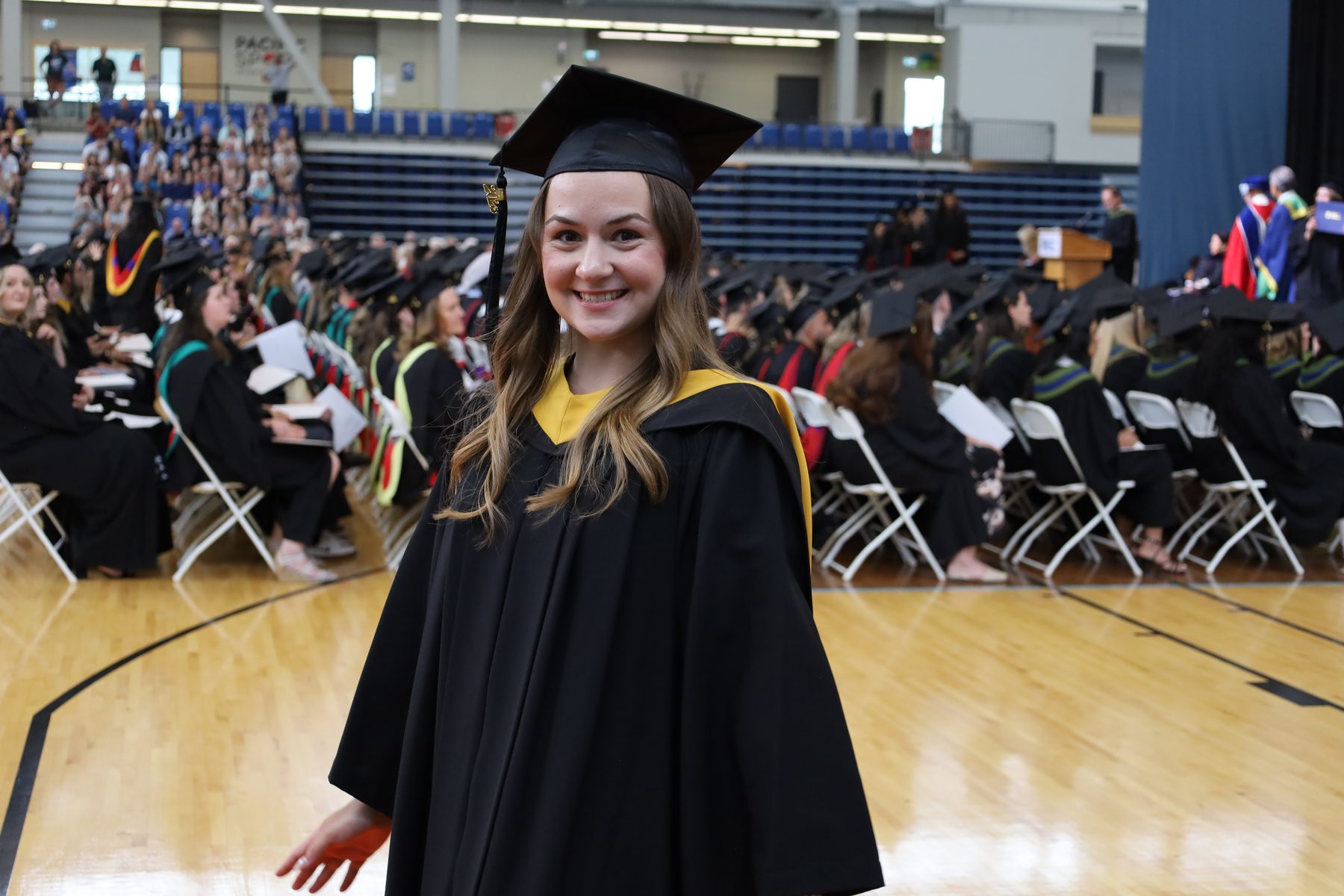
Celebrate
Graduate students may apply to graduate at any time before Convocation date for Spring or Fall ceremonies by going into the TRU portal under the Applicant & Student Self-Serve tab and selecting the menu option Application to Graduate. Payment is made online on or before February 1 (Spring Convocation) and July 1 (Fall Convocation). A late fee is assessed after the deadline dates.
When you are ready, you can apply to graduate and don’t forget to join us at Convocation at our Grad2 reception.
PreviousPlanning
NextGRADvantage