
Getting Started · Lesson 2
Supervisor Styles
Explore different supervision styles to understand your approach, align with your student’s learning style, and create a more effective mentoring relationship.
Module Objectives
By the end of this module, you will be able to:
- Explore different types of supervisor styles and reflect on your own
- Use various supervisor style models as a reference
- Find ways to be flexible in your supervision style to successfully support your student
- Gain access to useful resources
Principles of Supervision
Principles of Graduate Supervision in this module
This space is reserved for TRU’s Foundations of Graduate Supervision / Principles of Supervision. They will be added here once approved by the Graduate Senate Committee.
Effective Supervision
A productive working relationship between supervisors and students is based on mutual trust and clear expectations, and is grounded in principles of academic integrity, freedom of inquiry, and mutual respect. These relationships must be free from any form of discrimination, intimidation, or harassment, fostering a supportive and inclusive academic atmosphere.
Take a moment to think back on your own experiences being supervised:
- What aspects of that experience were positive?
- What aspects of that experience were challenging?
Take note of these reflections and revisit them as you go through this module.
Understanding Supervisor Styles
There is no “one style fits all” model for student supervision. As you review the following models, please take note and ask yourself:
- What styles feel more authentic or inauthentic?
- How does my supervisor style compare? Which style most resonates with me?
- How does my style complement/distract from my student’s learning style?
- How can I best support my student, considering what style I tend to lean towards?
Supervisor Styles
The following figure is adapted from “An Approach for Continuous Supervision of Bachelor’s and Master’s Theses in Engineering Studies”. https://link.springer.com/chapter/10.1007/978-3-030-90677-1_30#Sec2
Supervisors can be divided into four categories:
- Controller: The supervisor takes the main responsibility for the thesis and for the whole process. The supervisor specifies the topics, sets deadlines, and usually has a clear expectation of the outcome of the work.
- Gatekeeper: The supervisor works with students, who take responsibility for the thesis writing process and organize themselves. The supervisor has a clear expectation of the outcome and feels responsible for the outcome.
- Supporter: The supervisor defines the topic of the thesis and a clear process for supervision. During the process, students have defined submissions to track the progress of the work and receive feedback. Students have the primary responsibility for the outcomes of the thesis.
- Coach: The supervisor allows students to work in a self-organized manner. Coaching sessions are provided at the students’ request. Students have the primary responsibility for the outcomes.

Supervisor Style – Supervisor Management Grid
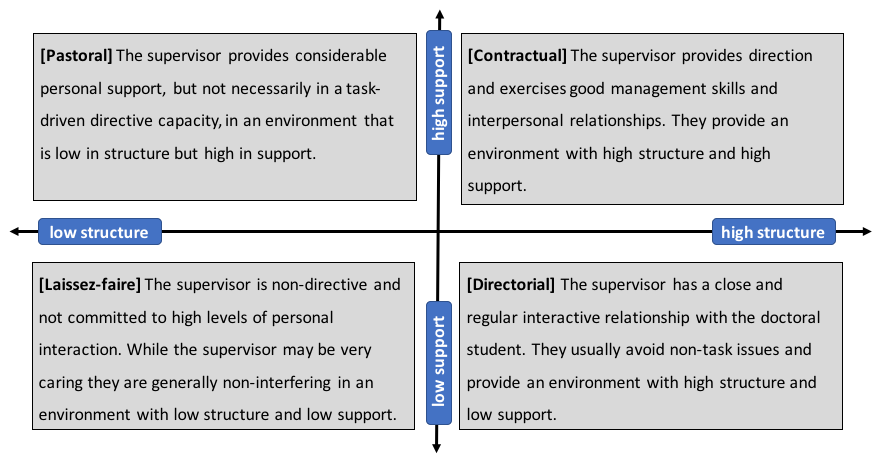
The following figure is adapted from Gatfield (2005) taken from University of Toronto Supervision Guidelines for Faculty. https://www.sgs.utoronto.ca/resources-supports/supervision/supervision-guidelines/supervision-guidelines-for-faculty-section-3-supervisory-styles/
Pastoral Style
- Low structure and high support
- Candidate will take advantage of their own personal management skills or find support offered through on and off-campus resources
- Supervisor provides considerable personal care and support, but not necessarily in a task‐driven directive capacity
Laissez-faire Style
- Low structure and low support
- The candidate has limited levels of motivation and management skills
- Supervisor is non‐directive and not committed to high levels of personal interaction
- A supervisor may appear uncaring and uninvolved
Directorial Style
- High structure and low support
- Candidate is highly motivated and sees the necessity to take advantage of engaging in highly structured activities such as setting objectives, completing and submitting work on time independently, without taking advantage of institutional support
- The supervisor has a close and regular interactive relationship with the candidate, but avoids non‐task issues
Contractual Style
- High structure and high support
- Candidate is highly motivated, able to take direction and act on their own initiative
- The supervisor can provide direction and exercise good management skills and interpersonal relationships
- Most demanding in terms of supervisor time
Supervisor Style – Understanding Supervisor Styles
The following figure and information are shared from the GO-GN Guide to Doctoral Supervision. https://go-gn.net/wp-content/uploads/2024/10/20241025-GO-GN-Guide-to-Doctoral-Supervision.pdf
The role of a supervisor is multifaceted, encompassing a range of responsibilities that extend beyond merely overseeing the student’s research. Supervisors serve as intellectual guides, professional mentors, and sometimes even project managers, shaping not only the student’s academic output but also their personal and professional development. The balance between these roles can shift depending on the student’s needs, the stage of the doctoral process, and the nature of the research project. Understanding the different aspects of the supervisor’s role can help both students and supervisors navigate their relationship more effectively and contribute to a more productive doctoral journey. Below, we highlight some ways of thinking about these aspects:
The Model
Setting Professional and Academic Standards
“I consciously model my supervision practice after my own supervisors’ exceptional practice, as well as model after experienced colleagues who have become my mentors as a professor.” – Michele Jacobsen
This role highlights the importance of leading by example and modelling the intellectual and ethical standards that students will carry forward into their own careers. As a model, the supervisor serves as a professional role model, demonstrating the behaviours, attitudes, and academic standards that the student should aspire to in their own career.
This modelling involves embodying qualities, such as academic integrity, ethical research practices,
effective communication, and professionalism, in teaching and research. Through their own actions and achievements, supervisors can inspire students to cultivate similar traits, helping them to navigate the broader academic world. By observing how their supervisor handles challenges, networks with peers, or approaches scholarly work, students can gain insight into what it means to be a successful researcher and academic.
In some cases, doctorates are connected with specific research projects, allowing supervisor(s) and supervisees to collaborate directly.
The Mentor
Fostering Intellectual and Professional Growth
“I get a mentor, someone who I respect immensely, great feedback and advice, humour, support, encouragement, a role model who isn’t afraid to learn new things.” – Jessica O’Reilly
As a mentor, the supervisor’s primary responsibility is to nurture the student’s development as a researcher. This involves guiding the student through the complexities of their research field, providing critical feedback on their work, and encouraging them to engage with broader academic debates.
Mentorship is not limited to academic content; it also involves the supervisor offering advice on how to navigate the often-unwritten rules of academia, such as how to publish papers, present at conferences, or build a professional network. The mentor role often involves a long-term view, helping the student prepare for their post-doctoral career by offering insights into job markets, grant applications, and opportunities for postdoctoral research.
Effective mentors inspire their students to think critically and independently, gradually stepping back as the student becomes more confident and capable in their scholarly work.
The Manager
Structuring the Process
“My supervisor went out of his way to advocate for me when needed, including when navigating bureaucratic hurdles. When another member of my supervisory committee was retiring (and so would no longer meet the department criteria for committee membership), he drew on his relationships to secure another supervisory committee member, with the shared understanding that the retiring faculty member would continue to perform these duties.” – Rajiv Jhangiani
It’s crucial to understand that doctoral students remain responsible for the overall management of their research. However, the supervisor also contributes to project management, providing the structure necessary to guide a student through the complex and often overwhelming process of completing a doctorate. This managerial role might include setting deadlines, ensuring that the student’s work is progressing on schedule, and helping them prioritise tasks, particularly as the research project evolves.
Supervisors must be aware of institutional regulations, timelines for submission, and the bureaucratic aspects of the process, such as ethics approvals and thesis submission protocols. Managing this process requires institutional knowledge, organisational skills, and a practiced understanding of the academic milestones that students need to reach.
The Muse
Sparking Creativity and Original Thought
“A research supervisor should truly be a motivator that pulls out the best idea from the student’s mixed thoughts and dreams.” – Judith Pete
In their most inspirational role, the supervisor can act as a muse, encouraging the student to think creatively and explore new ideas that push the boundaries of their field.
While the doctoral process often demands rigour and discipline, it also requires moments of intellectual risk-taking and creative problem-solving. A supervisor acting as a muse may stimulate the student’s curiosity by challenging assumptions, suggesting alternative methodologies, or introducing interdisciplinary perspectives.
This role often involves encouraging the student to step outside their comfort zone, engage with bold questions, and contribute original insights to the academic community through research discourse. By fostering a sense of intellectual freedom and encouraging creative thinking, supervisors help students develop their unique scholarly voice, a key component of producing original research that makes a meaningful impact.
The Mediator
Navigating Conflicts and Challenges
“About 50% of doctoral supervision is subject knowledge, and 50% is emotional support so be prepared to do the latter.” – Anonymous Contribution
As a mediator, the supervisor helps students navigate challenges, conflicts, and setbacks that inevitably arise during the doctoral process. These might involve disagreements over research direction, issues with co-supervisors or collaborators, or even personal and emotional difficulties.
The supervisor’s role as a mediator includes providing support during moments of academic frustration or self-doubt, helping to resolve conflicts diplomatically, and maintaining a positive, productive environment. This role requires emotional intelligence and the ability to listen, empathise, and offer solutions that are both practical and respectful of the student’s needs and academic integrity.
Supervisors who act as effective mediators foster a supportive environment where students feel comfortable discussing obstacles without fear of judgement, helping them stay focused on their goals.
The Motivator
Encouraging Persistence and Resilience
“My supervisor was always willing and available to talk with me whenever I had problems related to my dissertation, always provided me with sound advice and provided me with prompt feedback on every draft I submitted (more than 10). He also helped me think outside the box and constantly motivated me to continue the process during some of the very difficult periods of the dissertation writing process.” – Viviane Vladimirschi
As a motivator, the supervisor plays a crucial role in keeping the student engaged, motivated, and resilient throughout the long and often vexatious doctoral journey. Research can be isolating and discouraging, particularly when progress is slow or challenges seem insurmountable. In this role, the supervisor provides encouragement, celebrates milestones, and helps the student maintain momentum when motivation wanes.
By offering positive reinforcement and reminding the student of their achievements and potential, supervisors help cultivate a sense of confidence and perseverance. An effective motivator also understands when to push the student to meet deadlines and when to offer reassurance and support during periods of stress. This role is particularly vital during the final stages of writing or when setbacks occur in research, helping students remain focused and determined to complete their doctorate.
Farrow, R. (ed.), Ashman, M., Baff, D., Bozkurt, A., Dubien, D., Eldridge, B., Elias, T., Iniesto, F., Jacobsen, M., Jhangiani, R. S., Johnson, K. R., Johnston, S. L, Katz, S., Khetarpal, M., Mayisela, T., McGreal, R., O’Reilly, J., Peramunugamage, A., Pete, J., Pitt, B. & Vladimirschi, V. (2024). The GO-GN Guide to Doctoral Supervision. Global OER Graduate Network / Open Education Research Hub. https://go-gn.net/wp-content/uploads/2024/10/20241025-GO-GN-Guide-to-Doctoral-Supervision.pdf
Reflection
When supervising a student, there are several important questions to ask yourself to ensure you are providing effective, supportive, and ethical guidance. Here are some key considerations:
Am I clear about the student’s goals and expectations?
- Have I discussed and understood what the student hopes to achieve in their research and academic journey?
- Are the goals and expectations we have for their work aligned and realistic?
Am I providing the right level of support?
- Am I offering sufficient guidance, without being overly prescriptive?
- Am I providing the appropriate resources, feedback, and encouragement for the student’s growth?
Is the student’s workload manageable?
- Is the student balancing their research with other responsibilities?
- Have I helped them set realistic timelines and manage expectations for their progress?
Am I creating an inclusive and respectful environment?
- Am I fostering an atmosphere where the student feels comfortable expressing their ideas, concerns, and questions?
- Am I ensuring that my communication is respectful and free from any form of bias, discrimination, or intimidation?
Is my feedback constructive and clear?
- Am I giving feedback that is specific, actionable, and encouraging?
- Have I provided both positive reinforcement and areas for improvement in a way that motivates the student?
Am I being consistent in my approach?
- Am I offering consistent support, feedback, and direction?
- Have I been clear and consistent in setting expectations and addressing issues?
Am I fostering independence and critical thinking?
- Am I helping the student develop the skills they need to work independently?
- Am I encouraging the student to think critically and engage with their field of research?
Am I addressing the student’s well-being?
- Have I been mindful of the student’s mental and emotional health throughout the process?
- Am I providing an environment that supports the student’s overall well-being, not just their academic success?
Am I being a good role model?
- Am I demonstrating professionalism, academic integrity, and ethical conduct in my own work?
- Am I modeling the attitudes and behaviors I expect from the student?
Am I promoting opportunities for growth and networking?
- Am I encouraging the student to seek out networking opportunities, professional development, and collaboration within their field?
- Am I helping them connect with resources and people that can expand their academic and career opportunities?
By regularly reflecting on these questions, you can ensure that your supervision remains effective, supportive, and aligned with the student’s needs and goals.
Final Thoughts
The following is shared from the University of Toronto Supervision Guidelines for Faculty. https://www.sgs.utoronto.ca/resources-supports/supervision/supervision-guidelines/supervision-guidelines-for-faculty-section-3-supervisory-styles/
The research has shown that students across every discipline value supervisors who are:
- Accessible: Supervisor meets with students frequently in both individual and group settings.
- Approachable: Supervisor creates a comfortable environment where students can discuss concerns.
- Encouraging: Supervisor provides research support, guidance, and motivation.
- Interested: Supervisor is interested in the students and wants to know them as individuals.
- Open and flexible: Supervisor discusses expectations and conflicts openly and honestly and adjusts to students’ needs over time.
- Professional: Supervisor facilitates the student’s socialization into the program and discipline, encourages participation in conferences, and introduces students to people in the field.
- Supportive: Supervisor provides professional and career development support.5
PreviousYour Role as a Supervisor